August 9, 2012

Day 31/33 - Sunrise: Song of Two Humans (1927)


German film director F.W. Murnau's 1927 film Sunrise: Song of Two Humans won an Academy Award in 1929 for Unique and Artistic Production. It was the one of the first films to have a  soundtrack and sound effects recorded with the film. Although the original negative was destroyed in 1937, a second negative was created in 1989 from a surviving print. In 2007, the film placed 82 in a list of 100 best films in the history of cinema by the American Film Institute.

Murnau, an Expressionist, often distorts the visual image to show the inner emotion of the characters. His establishing shots seem filtered to give an Impressionistic view of the black and white world of his story. The farm scene might be painted by Van Gogh. The amusement park reminds me of some of the shots of Rouge City in Steven Spielberg's A.I.: Artificial Intelligence. The exaggerated city set  utilizes huge stylized sets in the foreground and smaller sets with smaller people in the background (today this would be done with computer graphics). The city set alone cost $200,000 to build.

The story is a fairly simple morality tale, with characters named only by type: The Man, The Wife, The Woman from the City, The Maid, etc. We begin with a drawing of a city train station that dissolves into a life action matte shot of real people against a miniature model train in the foreground, obscured somewhat by the "smoke" from another even closer train. This pulls us away from the urban world to the world of vacations. Eventually we are pulled to a country resort where The Woman from the City (Margaret Livingston) lingers after the other vacationers have left. [We know she is an evil city woman because she wears a black sheath dress and patent leather high heels while walking in the country.] She is having an affair with a married farmer, The Man (George O'Brien). She comes to his farm and whistles for him to join her. He leaves his wife (Janet Gaynor), who is fixing dinner, and joins her. After passionately kissing, she proposes that he drown his wife and come to the city with her. She even picks a bundle of bullrushes for him to use as a flotation device to save himself when he overturns the boat.

The older Maid tells some gossips that the couple were once very happy and laughed a lot.

The Man goes through torment picturing himself drowning his wife, but he proposes a trip in a boat to the city. He puts the bullrushes in the bow of the boat. The Wife says goodbye to their young child and when she enters the boat, their dog who is being protective, breaks loose and swims to her. The Man returns to the home, ties up the dog and begins again. Midway across the water, the Man stands threateningly confronting his wife. She becomes frightened and he relents. When they reach shore, he tells her not to fear him but she runs away.

The Wife runs to a trolley and he joins her as they go into town. The farmer and his wife are roughly dressed as opposed to the sophisticated 1920s costumes of the urbanites. The couple ends up at a restaurant where he brings her a huge plate of pastries. They leave and he buys her a bouquet of flowers from a street vendor which she carries for the next scenes.

The two end up in front of a church where a wedding is taking place. They join ceremony and during the wedding, the presider admonishes the groom it is his job to protect his wife from all harm. The Man breaks down sobbing and the wife forgives him. The bride and groom's wedding become theirs and they exit the church as if a newly married couple, ready to start again.

They pass a photography shop and the Wife proposes they get their portrait taken. She realizes he needs a shave, so they go to a swank barber shop. The owner assumes she wants her hair styled, but she refuses. The Man gets a his shave. While he is shaved, a pretty manicurist tries to do his nails as the wife jealously watches. When he refuses, she is relieved. Then as his shave continues, a man sits beside the Wife and tries to pick her up. He takes one of her flowers and puts it in his lapel. Finally, finished shaved the Man pulls a knife and threatens the accoster.

The couple have their picture taken. As they are posing, they laugh and kiss and the photographer takes the kiss as their picture. While he is developing the picture, the two have a rather silly scene where they end up kissing and knocking off a Greek statue, breaking its head.

As they walk into the street (using rear view projection), the street becomes an idyllic meadow where the two of them ultimately kiss. The meadow becomes once more a street scene and the two have created a traffic jam.

The two end up at a highly stylized larger than life Coney Island-type amusement park/dinner club. The Man throws balls to free a pig. One small pig escapes and runs through the dinner club with the man chasing it. There is a comedy scene where a waiter drinks wine and then sees the pig hidden under a tablecloth and assumes he is drunk. When the Man captures the pig, everyone is happy and the two end up dancing a peasant dance (although the Wife has to convince the husband to do it). After having some wine and barely scraping together enough between them to pay for the bill, they start home.

In moonlight they take the trolley back to the boat and begin sailing home, which the Wife says will be like a Honeymoon.

Out of no where, a storm ravages the city and it finally hits the lake and the farm. The Man pulls out the bullrushes and ties them to his wife. A huge wave knocks them out of the boat.

When the storm passes, it is still night and the Man awakens in the water by the rocky shore. He runs for help and a group of men get out boats to help him search for the Wife. The Woman from the City watches what is going on. As they search, we are shown the woman floating, clutching to the bullrushes, but many loose rushes are floating around her. The Man finds the straggling bullrushes and assumes his wife is dead. He returns desoluted to the farm. The Woman from the City comes and whistles for him to come to her. He comes and attacks her. Just as he is ready to strangle her, the Maid calls him. The Wife has been found by some of the men, alive and well. He rushes to her side and they reunite.

As the sunrises, the Woman from the City returns to the city and the Wife awakes with her child and husband beside her. They kiss and the sun fully rises. Finis.

The film acting is much broader than we expect today, but some of the scenes, such as the church wedding scene are highly effective. George O'Brien and Janet Gaynor make appealing Everyman and Everywoman and do elicit our sympathies.

The drowning of a partner for the affections of another has elements of Theodore Dreiser's An American Tragedy, published in 1925 and made into a movie by Josef von Sternberg in 1931. Dreiser's book was based on a real incident. A 1951 version had the famous kiss of Elizabeth Taylor and Montgomery Clift's A Place in the Sun and became one of the great film kisses.

Murnau's film is based on "Die Reise nach Tilsit," a short story by Hermann Suderman. The film, although American made, has the feel and look of a German morality tale.

Sunrise: Song of Two Humans (1927) ****

The film is found on You Tube and can be downloaded or streamed here.


Note: If Hollywood were ever to make a film about George O'Brien, they might consider Michael Fassbinder. See a publicity shot of O'Brien below:


August 8, 2012

Day 30/32 - We Have a Pope (2011)


"Habemus Papam" is the decree the college of cardinals make when they select a new pope. The film begins with brief glimpses of the previous pope's funeral and then all the cardinals walks in line to the Sistine Chapel, the historic room upstairs in the Vatican. As the voting for the new pope begins, tensions mount and we hear what each of the cardinal's is thinking, "Please God, not me." When the voting is finally finished, a totally unexpected candidate, pious, simple, a John-Paul type, Cardinal Melville is named pope. When he answers the standard question about accepting the position, he says, "Yes." But as the is being introduced to his new flock, he screams and runs away. The new pope doesn't want to be pope.

I found the opening highly moving and beautifully acted.

As Il portavoce (Jerzy Struh) tries to figure out how to deal with the sensibilities of Il papa (Michel Piccoli), Lo psicoanalista (director, cowriter Nanni Moretti), the best psychiatrist they can find in a hurry is brought in.  He tries to conduct a session with his patient, but no one will tell him his name and he has to do the session with all the cardinals watching. Quickly we learn that he is an atheist and a humanist, and while he sincerely wants to help, no breakthroughs come. He does mention that his wife is considered the second best psychiatrist in Rome, and Il portavoce sets up an appointment with her. Her take is that all neuroses stem from parential deficiencies. Il papa, who cannot tell her he is pope, tells her he is an actor, a wonderful metaphor for all the actor/priests I know. Il papa in his existential conflict, ditches his security as he leaves and much of the film deals with their attempts to find him, make everyone believe Il papa is praying in his suite, and Il papa's coming to terms with his ultimate delemma.

There were for me truly delightful moments in the film:

  • Lo psicoanalista organizes the cardinals in a volleyball tournaments where they are allowed to show their wonderful humanity.
  • The cardinals hear music they think Il papa is listening to and become enraptured with the music.
  • Il papa wanders the Papal gardens while the Swiss Guard prepare. Their encounter is charmingly done.
  • Il papa ends up watching a performance of Chekhov's The Sea Gull, for which he knows all the lines. The actors he had encountered earlier and one of them--most like himself--seems driven mad by his role. Another metaphor. As the audience watches, all the cardinals appear in the audience in full robes and hats, ready to bring Il papa home. I found the scene as stunning as Hitchcock's Doris Day at the orchestra performance in The Man Who Knew Too Much. Doris Day's scream punctuates Hitchcock's scene. Here, one of the gentlest of the cardinals shyly waves to the pope and smiles.
[Spoiler alert] At the showing I saw, we discussed the ending. Il papa, who has spent his life taking the orders of the Church, dresses in his robes to deliver his first speech as pope, and refuses to accept the position. Many in the audience felt showed that he had not learned or grown in the journey we watch him take. I totally disagree. Cardinal Melville tells one of the psychiatrists that he has nothing to say, that all he knows has flown out of the window. It is through his encounter with this existential dilemma that Cardinal Melville finds the strength to realize that he has the ability to say no and step down. It is a totally surprising, but for me a totally reasonable dramatic completion of the film.

As a Roman Catholic who visited the Vatican last summer, I was totally moved by the film.

We Have a Pope (2011) ****


August 6, 2012

Day 29/31 - Tokyo Story (1953)

The story is simple. Shukishi and Tomi Hirayama, an elderly couple from distant Onomichi, visit their children in Tokyo. Their children primarily view the visit as an inconvenience, but any disapproval is hidden behind the face of courtesy. Son Koichi, a doctor in a modest section of Tokyo, agrees to take them sightseeing on Sunday, his day off, but a patient ends up requiring his attention. Widowed daughter-in-law Noriko welcomes them and entertains them for the day. Later, upset that the elderly couple are taking up too much time and attention, the couple's beautician daughter Shige and husband send them off to a spa. At the spa, the elderly couple are kept awake by the crowds of young people, gambling, partying and listening to a live band. The couple return to Tokyo realizing they are in younger people's way. When Shige makes it clear they have upset her plans, they decide to split up for the night. The mother goes to spend the night with her Noriko and her husband goes to visit a friend unannounced, hoping to get an invite for the night. Shukishi ends up with two friends, going out drinking till late. He and one of the friends return to his Shige's house drunk. She berates him for being a drunkard, saying that he had had this problem before. The couple decides to return home, but on the trip back the wife becomes ill  and it takes longer for them to return. The wife becomes critically ill and eventually dies with her children (except one) around her. The father is left at the end, telling a neighbor if he had thought his wife would die so soon, he would have treated her better.

The director stations his camera directly on so we get almost a static stage set. The walls bookcase the image and give a feeling of claustophobia to Tokyo. People move into other rooms and instead of cutting immediately to follow them, the director keeps the camera running a couple of beats longer than Western directors would, leaving the rooms as silent witness to these people's empty lives.

The line delivery is stilted and formal.  This is a film where subtext is very important, not what is actually said. We are shown individual heartbreak and regret, but in most cases it is restrained by Japanese convention. The father expresses disappointment that his doctor son is only a general practitioner. His wife finds she cannot relate to her youngest grandson. The daughter-in-law tells the father she is not the good woman he and his wife believe her to be. Shige tells her husband, when he brings home expensive cakes for her parents, that crackers are good enough for them, obviously preferring them for herself.

One of the visual motifs of the film are school children walking and running to school in contrast to the much slower movements of the grandparents.

This film was listed as one of the top films ever made by both critics and directors in the 2012 Sight and Sound magazine. While the movie and its characters do linger in my thoughts, I would probably not be able to have it in my top 100. Perhaps, given time, I would change my mind.

Tokyo Story (1953) ****


The entire film is found here on You Tube.

August 5, 2012

Day 28/30 - Brave (2012) & La Luna (2012)

I came to see Pixar/Disney's Brave later than most. I've been careful to avoid reading reviews and getting friend's opinions, because I wanted to feel I was seeing it on my own. My first reaction was, "Wow, they finally got past the kill the mother off and give the female protagonist a father-figure to relate to!" The mother is in peril in this film, but together she and her daughter resolve the problems. What a major step ahead, I thought.

For those few who haven't seen or heard about the movie, the film centers around Princess Merida (voiced by Kelly MacDonald) from a Scottish kingdom. We first see as a child celebrating her birthday with her parents in the woods. The father is attacked by a bear and later we are told he lost his leg to him. Merida's bravery and love of the bow is established in the beginning. A true child of nature, Merida matures into a red-headed Boudica proficient with a bow and arrow, the equal to her father, Lord Fergus (Billy Connolly). Her mother, Lady Elinor (Emma Thompson), feels it is time for her daughter to be married and thus the conflict begins. When three clans arrive to claim Merida's hand, she outshines them all with her archery skills and argues with her mother, tearing a tapestry her mother had created to Merida, her, and Fergus. Merida rides off into the woods with her draft horse and is led by will-o'-the-wisps to the cottage of a bear-carving witch. Merida asks for a charm to change her future. She is given a potion that will turn her mother into bear. Once done, she discovers that if she doesn't turn her back in two days, she will stay a bear.

I was bowled over by the beautiful rendering of textures. Merida's hair is beautifully deliniated with individual strands evident on the large screen. According to the IMDB article, Merida has 1500 individual strands of hair. The hair on the horse and the bear are also worth studying. But I was most impressed with the dress fabrics (with the sheen of raw silk) of Elinor and Merida. Contrast them to the wools of the men's kilts and scarves. All in all the film is a feast for the eyes and one of the most full rendered and realized Disney/Pixar films done.

I found myself utterly enchanted with the story and theme. I'm sure the children in the audience with me today felt the same. This is the best Disney experience for me since the first Toy Story.

Brave (2012) *****


I should also note that the short subject with the film, Pixar's La Luna was an captivating tale of three people who sweep the stars up on the moon. This short piece was well worth the price of the admission by itself.


La Luna (2012) *****

August 4, 2012

Day 27/29 - The Man with the Movie Camera (1929)

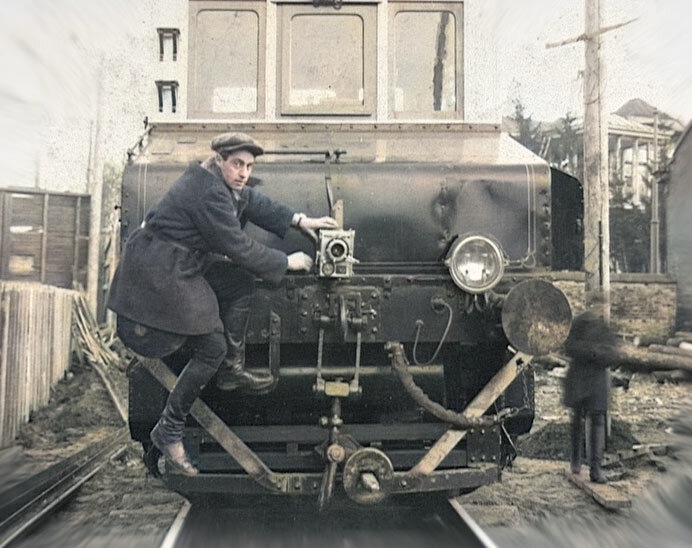
Mikhail Kaufman acts as the cameraman to get a shot from a moving train, from Wikipedia. Remember, these movie cameras were hand cranked, not automatic.
If you have become involved in the new technology of Instagram or Hipstamatic, you know about the variety of images that bombard you in your feed every day. I am fascinated by that immense variety. Taken together they give us an interesting view of our modern world. 

Now, imagine taking that variety of images, combining them with cinema techniques, such as film montage, split screen, double-exposure, stop-action, and you have a pretty good idea of the 68 minutes of the 1929 Russian silent film by director Dziga Vertov called The Man with the Movie Camera. 

Recently, Sight and Sound magazine did a survey and Vertov's film ranked No. 8 in 846 critics greatest films.

Vertov states at the beginning that the film is intended as "AN EXPERIMENTATION IN THE CINEMATIC COMMUNICATION OF REAL EVENTS, WITHOUT INTERTITLES, WITHOUT A SCENARIO, WITHOUT THE HELP OF THEATRE (actors, sets, etc.)" 

The cutting and pacing of the film (done by Vertov's wife, Elizabeta Svilova) often reminds me of an interview George Lucas did regarding Star Wars where he said that they experimented to see how fast they could cut from image to image and have the eye still register it. The film does the the same. With the fascination of speed and movement, there are parts that become a thrill ride of visual stimuli.

The film begins by taking us into a movie theatre where we see the projector and the audience, reminding us that this is cinema.

The film is primarily urban based. Vertov (and his cameraman, Mikhail Kaufman) show us a full visual dictionary of Russian life, filled with store windows, mannikins, trolleys, posters, people working, pistons, mailmen, crowds, cars, factories. The camera is constant throughout. Never are we to assume he is not there. In one early sequence we see a horse-drawn carriage and its occupants, then we see the cameraman, then we see shots of the cameraman with the carriage and its occupants. As we get into the pacing of the horse running, we suddenly stop and see still photographs and eventually photographs of the film strips themselves and Elizabeta cutting them into sequences.

The editor has a wonderful sense of juxtaposition of themes and variations, mixed with irony. A couple register a wedding, another registers a divorce, a woman gives birth, a funeral carriage bears the open casket of a young man surrounded by flowers.

We see fingernails being worked on, women's hair being cut, makeup and eyebrows being applied, and move on to see sewing and counting money; newspaper printing cuts to a woman who creates cigarette packages and eventually hands packing cigarettes into the same packages.

We see the ever-present cameraman on top of trucks, trains, cranes over dams, deep in coal mines and factory iron vats.

We move from people learning to swim, to relaxing at the beach, to a newspaper layout and a whole montage on sports--among others, jumping hurdles, horse racing, diving, basketball, soccer, motorcycle racing, often in slow motion.

In a beer garden there is a trick shot of the cameraman in a beer glass, people drinking, bottles of beer and wine. These lead to shot of a woman at a shooting arcade, shooting at a metal woman with a swastika on her head (perhaps the only image for me that truly locks the viewer into the time period).

Near the end, there are more and more pictures of the cinema where we started with the cameraman seen in various shots. Often the cutting here is from images of action to static, almost still pictures of people reacting. 

As much a part of the film as anything is the musical soundtrack played by The Alley Orchestra, using a full range of instruments, along with bottles, spoon, washboards, pie pans, bells, all supporting the moods of the various montages. [Note, the musical score in the YouTube version of the film is not the one I heard, which was supposedly based on the original. Like Metropolis, you can find various versions, each making the experience slightly different.]

The film is indeed "pure cinema." It reminds me of what Anton Chekhov states regarding his view of a naturalistic theatre: 
After all, in real life, people don't spend every moment in shooting one another, hanging themselves, or making declarations of love. They do not spend all their time saying clever things. They are more occupied with eating, drinking, flirting, and saying stupidities. these are the things which ought to be shown on the stage. A play should be written in which people arrive, depart, have dinner, talk about the weather, and play cards. Life must be exactly as it is and people as they are. Let everything on the stage be just as complicated, and at the same time just as simple, as in life. People eat their dinner, just eat their dinner, and all the time their happiness is taking form, or their lives are being destroyed.
Vertov has shown us that world which has disappeared.

The Man with the Movie Camera (1929) ***** (iTunes or YouTube)


August 3, 2012

Day 26/28 - Ai Weiwei: Never Sorry (2012)

The Bird's Nest, Beijing National Stadium (2008), for which Ai Weiwei was the artistic consultant.

You might recognize the name Ai Weiwei as the artist who created the Bird’s Nest Stadium for the 2008 Beijing Olympics.  In 2011 ArtReview, in their annual Power 100 list, proclaimed him the year's number one artist and detailing his dramatic arrest and 81 day disappearance and detention. This creative activist had pulled the dragon's tail too many times.

For those who know little of Ai's artistic life and contribution, a good place to start is this fascinating and powerful documentary of his work during the last few years. With depth and sensitivity, the filmmaker has brought us into his world of creativity, philosophy and social conscience.

The film begins with a powerful metaphor. In his studio lives many cats and dogs. But only one cat, says Ai, has learned to open the door. ... and the problem is, it has not learned to close it. As I left the theatre, I realized how deeply that applies.

A significant part of the film details Ai's fascination with antiques (like his dissident father before him who was imprisoned during Chairman Mao's attempt to destroy the past to create a new China). One work of his has painted a Hun Dynasty urn with the Coca Cola logo. Others have modern glazes. In one set of pictures, he drops a valuable antique urn and destroys it. His willingness to find art in the process of creation/destruction is similar to what he seems to want for Chinese society.

During one of the interviews for the documentary, the interviewer asks if they can interview his mother. He refuses but instead proposes that they select any woman to play his mother and let her say anything. He laughed that it would be one of his artworks.

In 2008, in response to the Sichuan earthquake, Ai became involved in gathering names of students who had died. The list grew to 5,385, but the Chinese government set out to silence Ai's work at publicizing the names. In 2009, while on a trip to testify on behalf of Tan Zuoren, another investigator of the earthquake, Ai was attacked by the police in his hotel room. After suffering internal bleeding and an operation and hospital stay, Ai set out sue the government and policemen involved. [Ai spent several years living in New York City and he says that once a person tastes of freedom, they can't return.]

Ai's method of attack was through his blog and publishing photographs. When the government shut that avenue down, Ai began using Twitter.

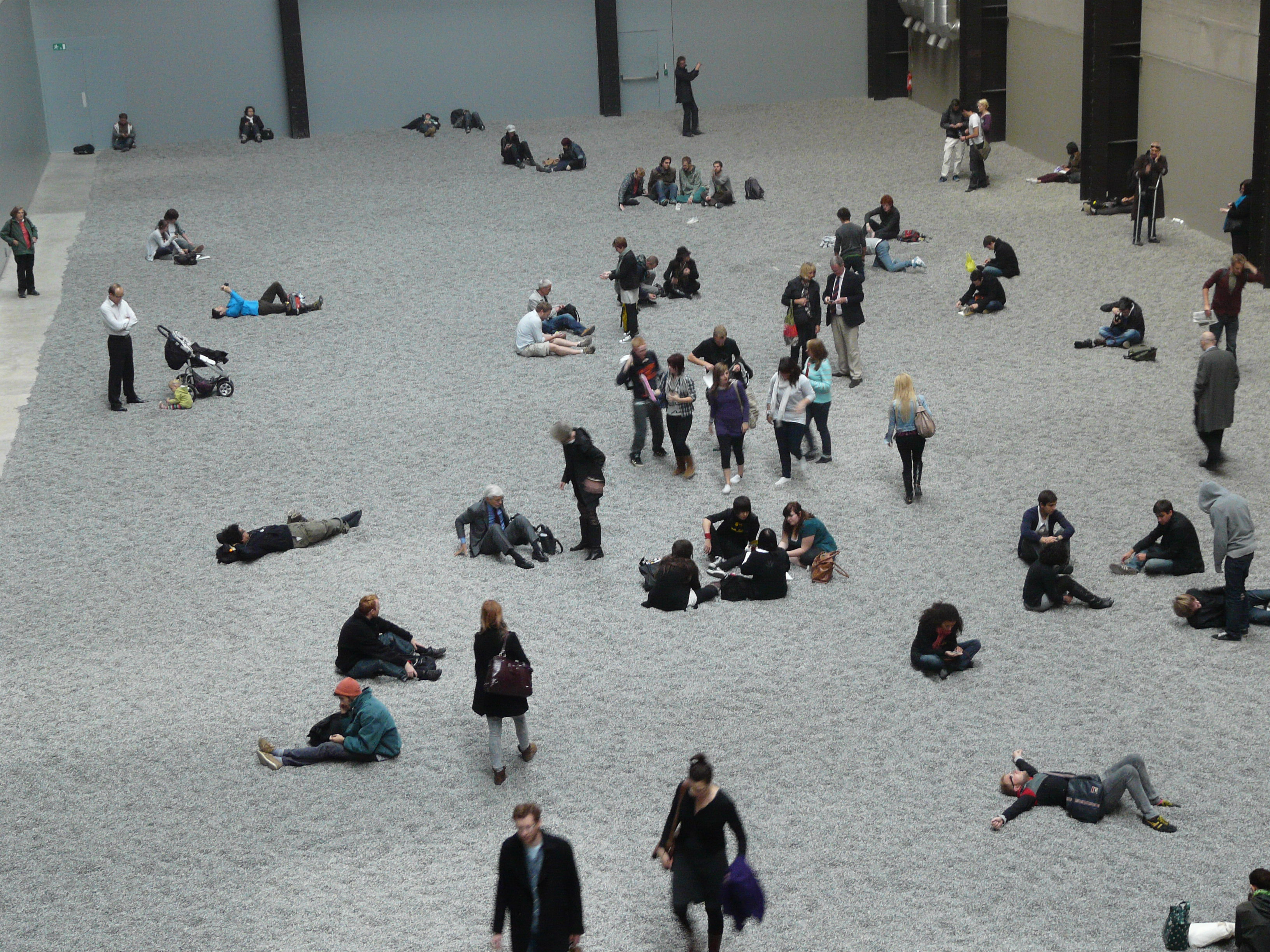
Sunflower Seeds by Ai Weiwei at the Tate Modern Turbine Hall. 
In 2010, Ai's installation, Sunflower Seeds, went on display at the Tate Modern Turbine Hall. Consisting of one hundred million porcelain seeds, all hand-painted, the piece became a visual metaphor of the power of the individual against the vastness of our uniqueness.

That same year, the government moved to silence Ai by announcing the pending destruction of his newly built studio in Shanghai. Ai immediately tweeted that they would hold a celebration dinner. He was put under house arrest so he could not attend, but  hundreds of his followers went ahead with the dinner, publishing photos of the experience. Two months later, the studio was demolished.

After his disappearance in April 2011, no one had news of his well-being or whereabouts for 81 days. Then in June 2011, a visibly shaken and cowed Ai reappeared and the film talks about how his work still continues. The government's attack on Ai has been for tax evasion and they have labeled him a "deviant and a plagiarist."

In The Dark Knight Rises, Batman says, "A hero can be anyone. Even a man doing something as simple and reassuring as putting a coat around a little boy's shoulders to let him know that the world hadn't ended." 


Ai Weiwei shows us what it means to be a true hero and how that costs the individual.

Ai Weiwei: Never Sorry (2012) *****


August 2, 2012

Day 25/27 - The Serpent's Kiss (1997)

Dutch painting from 1678, could have been used as source material for the costumes. 


I picked The Serpent's Kiss because I like the work of Ewan McGregor and I had never heard of the film.

Set in the William and Mary period of 1699, wealthy English landowner Thomas Smithers (Pete Postlethwaite) brings in Dutch landscape designer Meneer Chrome (Ewan McGregor), who had been recommended by his wife's cousin, to create an elaborate garden which will "tame nature" and showcase his house. Early on we have clues that Chrome may not be who he pretends he is. But he proves he knows plants and can name plant fragrance after fragrance even when blindfolded. He also can recognize the different scents of the mistress's perfumes. 

Daughter Thea or Anna (Carmen Chaplin) changes her name according to her mood. Thea seems quite mad and dreams of being cut down by the handsome reaper using his scythe around the estate. Under a doctor's grotesque 17th century care of leeches and heated cups, she longs to run wild in the estate's forest. 

Wife Julianna (Greta Scacchi) is dissatisfied with her life at the estate and welcomes the new stranger. Julianna's cousin, James Fitzmaurice (Richard Grant)--an Iago in the making--manipulates the building of the garden in an attempt to bankrupt his cousin's husband and exact revenge--for what we are not certain.

Chrome's garden is filled with logic and symmetry. When asked if there will be flowers in his garden, he explains it will be filled with man-made creations--walls, gravel walks, statues, and metal constructions. Later he even adds a large greenhouse for exotic plants.

When the garden is finished, Thea picks a dandelion from a path and as she blows the seeds, the wind picks up and as it building in a fury destroys the garden.

The film resolves itself in high 18th century melodramatic fashion, with the villain ironically punished and order being restored.

The costumes are sumptuous and evocative of period. And the mise en scene of the estate has the look of new money.

The plot reminded me of the 1982 film, The Draughtsman’s Contract, set in the same historical time period, where a cocky artist is hired by the wife of a wealthy landowner to produce twelve drawings. As he produces them, he realizes they may actually tell the story of the murder of the absent landowner. The Draughtsman’s Contract, however, is much more cynical than The Serpent’s Kiss.

In all, I recommend The Serpent's Kiss, especially if you like the work of Ewan McGregor and Greta Scacchi.

The Serpent’s Kiss (1997) ****


August 1, 2012

Day 24/26 - Goya's Ghosts (2006)


Milos Forman, who directed One Flew Over the Cuckoos Nest, Hair, Ragtime, and Amadeus, tackles the dark period in Spain when the last throes of the Spanish Inquisition fought the “modernist” ideas of the French Revolution and such dangerous humanist thinkers as Rousseau and Voltaire. 

The film opens with the Inquisition considering the prints of the king’s painter, Francesco Goya.  Decried for his “filthy” view of the world, Fr. Lorenzo (Javier Bardem) volunteers to take charge of making the Inquistion more diligent in eradicating the world Goya has depicted. Covert spying begins and any unusual conduct is reported. People are accused of crimes and locked up with little or no proof. (Sound familiar today? That's one of Forman's points.)

Natalie Portman plays three characters in the film. The first, Inés, is seen sitting for her portrait with Goya (Stellan Skarsgård).The innocent daughter of a rich merchant , she is later seen refusing pork in a tavern and is accused of being a practicing Jew. She is locked up, tortured (“being put to the question”—raising one’s arms behind one’s back and raised off the ground), and confesses.

Goya, who is painting Lorenzo’s portrait, is asked to help by Inés’ father. When Goya brings Lorenzo to dine, the father declares that anyone would confess anything to escape the pain being put to the question. When Lorenzo disagrees, the father has him tied up and "put to the question." He signs a confession the father had written saying he was born a monkey.

Lorenzo agrees to help Inés but when he goes to the jail where she is held, he ends up raping her. When the merchant brings Lorenzo’s confession to the king, Lorenzo flees to France and he is excommunicated, with his portrait being publically burned.

Jumping 15 years, the balance of power has shifted and the French control Spain. The Inquisition ends and all the prisoners are freed. Inés has languished in prison and is barely recognizable. She claims that she and Lorenzo had a child. Lorenzo returns successfully from France—no longer a priest, but now the chief administrator of the region, with wife, children, and little guilt.

The rest of the film deals with Inés trying to find her daughter, Lorenzo struggling to maintain power and the political upheaval brought by the British who invade Spain.

The script examines the morality (and immorality) of state-sponsored use of torture. It also questions the role of art and the artist. When viewing a painting of the Spanish queen, for example, one character says, “I don’t remember her being so ugly. How did she get all those lovers?” And earlier, when the queen sees another portrait of herself, she leaves without a word to Goya. What Goya seems to have ignored is her earlier telling that if nothing more, she wants him to paint her "beautiful." Perhaps that’s what the film is saying about film. Should we show the inhumanity to man that really existed or create a pretty costume piece?

One of the fascinating sequences of the film is seeing the steps Goya actually went through to create his etchings. While Goya is really only the adverb in the title, not the main noun, we do get a good idea of the man as artist, standing on the peripheral watching and recording events.

Seeing the range of Goya's art during the final credits is silent testament to the power of the artist.

While the film lacks the emotional impact of a work like Amadeus, it is a well-told study of Goya and his time period.

Goya's Ghosts (2006) **** (DVD)


July 31, 2012

Day 23/25 - Ruby Sparks (2012)


In this quirky summer romantic comedy, written by lead actress Zoe Kazan, acclaimed novelist Calvin Weir-Fields (Paul Dano) finds himself unable to write. His shrink (Elliott Gould) suggests that Calvin write about someone who totally accepts his toy dog, and that night Calvin begins writing about a woman he had dreamed about. He names her Ruby Sparks. 

His brother Harry (Chris Messina) reads his work, but he says she is totally unreal. Then one day Calvin wakes up and finds that Ruby is quite real and living with him. Calvin thinks he is hallucinating, but he discovers that other people can also see her. He decides to accept this miracle as a godsend. Only later does he begin to realize it might be a curse.

Although Ruby is totally devoted to him, Calvin discovers he can also make her do whatever he wants by typing it into his novel.

The film plays was lots of speculations.  What would happen if you could create your perfect mate? What kind of responsibility does the writer have toward his creation? Do you want someone in your life who you control or is it better to have someone who thinks and acts for themselves? Do we want people in our lives who are unpredictable?

The actors are fun to watch. Paul Dano and  Zoe Kazan have good chemistry and make offbeat romantic leads, with their non-Hollywood looks and eccentric personalities. When Calvin takes Ruby to meet his free spirit mother (Annette Bening) and his furniture-maker step-father (Antonio Banderas), Calvin questions whether he wants to share Ruby at all.

As the film meanders through the aspects of the couple’s relationship, it gets dark. Happily, the resolution feels sensible, and although I felt like I had seen the ending before, it fits.

I liked seeing True Blood’s vampire Jessica (Deborah Ann Woll) play Calvin former girl-friend.

Enjoy this film.

Ruby Sparks (2012) **** 


July 30, 2012

Day 22/24 - Cave of Forgotten Dreams (2011)


Chauvet Cave was discovered in Southern France by three men in 1994. Inside are some of the earliest human cave paintings, dating from some 32,000 years ago. Back in the distant past, the side of the mountain caved in and the cave was sealed into a time capsule. Only by chance did the three men find the cave, which was then named for one of the explorers.

Access to the cave has been limited to protect the site, but film maker Werner Herzog (Grizzly Man, Aquire: The Wrath of God) was allowed in to make a documentary of them. Since those in the cave have to stay on a metal path, the film crew of four are often in the sights of the cameras.

The site is fascinating. Not only are there depictions of cave lions and bears, horses, rhinoceros, but the site includes the carbon remains of the torches used to light the cave, footprints of animals and bone fragments.  

The water has calcified much of the surfaces so that they often glitter on film. A stalagmite rises from on top of a porcelanized looking bear skull. What appears to be a waving flounced cloth scarf has been formed from dripping water, creating a beautiful alternating pattern of orches and browns. This is a dream-world free from the constrains of time.

Scientists do not believe humans lived in the cave, but they certainly decorated and explored it.

In the rear of the cave are the footprints of a wolf and an 8 year old boy. Are these from the same time period or separated by millennium? The palm paintings of one individual show he is 6 foot tall with a crooked little finger and he has done paintings in several places. On one rock pedestal is a bear head placed facing the cave and on the ground around are carbon fragments from torches. Ceremonial? Probably.

The film was done in 3D, although I saw it on Netflix so I can’t speak for that aspect.

At times the ninety-minute film at times feels a little long, but when Herzog lets the cave speak for itself, it is fascinating.

Cave of Forgotten Dreams (2011) **** (Netflix)